Animals & Dust
Dust Mite
Dermatophagoides pteronyssinus / D. farinae
Season: Year-round, often peaking in humid summer months and early fall
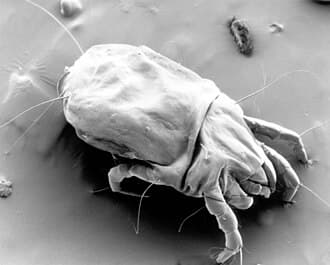
House dust mites are microscopic, eight-legged relatives of spiders that live in mattresses, bedding, carpets, and upholstered furniture, feeding on shed human skin scales. The allergens are proteins in their fecal pellets and body fragments — chiefly the digestive enzymes Der p 1/Der f 1 and Der p 2/Der f 2 — which become airborne when dust is disturbed and are among the world's most important causes of asthma and perennial rhinitis.
🇺🇸 History in the United States
House dust itself was identified as an allergen in the United States in 1921, when Robert Kern reported that asthmatic patients reacted on skin testing to extracts of dust from their own homes, and Cooke confirmed in 1922 that dust extracts gave positive reactions in a large share of allergic patients; for the next four decades 'house dust extract' was a staple of American allergy practice with its active ingredient unknown. In 1961, the mite Dermatophagoides farinae — now called the American house dust mite — was formally described by Hughes from US flour samples. The decisive breakthrough came in 1967 when Voorhorst, Spieksma, and colleagues in the Netherlands demonstrated that Dermatophagoides pteronyssinus and its products were identical to the long-mysterious house-dust allergen, a finding published in the Journal of Allergy and quickly confirmed in Japan and the United States, where D. farinae proved to be the dominant species in many American homes. In 1980, Chapman and Platts-Mills purified the major mite allergen Der p 1, and Platts-Mills' group at the University of Virginia went on to define exposure thresholds for sensitization and asthma and to lead US avoidance trials in the 1980s-1990s. NHANES III (1988-1994) found dust mite the single most common positive skin test in the US population at 27.5%, and inner-city and national asthma studies established mite allergen as a major driver of American childhood asthma. Standardized mite extracts were licensed in the US in the 1980s, and FDA-approved dust-mite sublingual immunotherapy tablets followed in 2017.
📍 US Distribution
Mites thrive wherever indoor relative humidity stays above about 50%, so exposure is heaviest in the humid Southeast, Gulf Coast, Pacific coast, and Midwest, and low in arid or high-altitude Western regions; exposure is indoors, concentrated in bedding.
🔗 Cross-Reactivity
D. pteronyssinus and D. farinae are strongly cross-reactive with each other, and mite tropomyosin (Der p 10) cross-reacts with shrimp and other shellfish.