Molds
Aspergillus Fumigatus
Aspergillus fumigatus (Asp f 1)
Season: Year-round, often peaking in fall and winter when decaying vegetation and indoor dampness increase
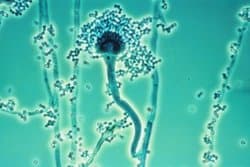
Aspergillus fumigatus is a heat-tolerant green-gray mold that grows on decaying organic matter, compost, and damp building materials, releasing spores so small they reach the deepest airways. Its allergens (Asp f 1 through Asp f 34, led by the ribotoxin Asp f 1) cause ordinary allergic asthma and rhinitis, and in susceptible people the fungus can colonize the airways to cause allergic bronchopulmonary aspergillosis (ABPA).
🇺🇸 History in the United States
The genus Aspergillus was named in 1729 and human aspergillosis was described in Europe in the 19th century, but its allergic dimension emerged in the modern era: allergic bronchopulmonary aspergillosis was first described by Hinson and colleagues in Britain in 1952, and the first US case was not reported until 1968, by Patterson and colleagues in Chicago. Through the 1970s, American work centered at Northwestern University — especially the Rosenberg-Patterson diagnostic criteria of 1977 — defined how ABPA is diagnosed and staged, criteria US clinicians still reference today. Aspergillus extracts had been part of mold skin-testing panels used by American allergists since mid-century, and US researchers helped standardize them; in 1990 Arruda, Platts-Mills, and colleagues cloned the major allergen Asp f 1, a ribotoxin, opening the door to recombinant serologic diagnosis. ABPA became a particular American concern in cystic fibrosis and severe asthma populations, with US registry studies from the 1990s onward estimating it complicates roughly 1-2% of asthma and up to 10% of cystic fibrosis cases. Analysis of NHANES 2005-2006 data later showed A. fumigatus sensitization is significantly associated with current asthma in US children, and the related concept of severe asthma with fungal sensitization (SAFS), framed in the 2000s, has shaped US asthma phenotyping.
📍 US Distribution
Exposure is nationwide and both outdoor (compost piles, decaying leaves, agriculture) and indoor (damp basements, HVAC systems, water-damaged buildings), with spores present in air throughout the US.
🔗 Cross-Reactivity
Aspergillus fumigatus shows significant cross-reactivity with Penicillium species and partial cross-reactivity with other Aspergillus species and molds.