Molds
Cladosporium Herbarum
Cladosporium herbarum (Cla h 8)
Season: Spring through late fall, peaking in summer and early fall; lower but persistent levels year-round in warm and humid regions
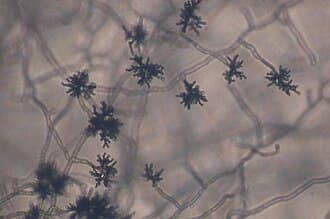
Cladosporium herbarum is an olive-brown mold that grows on dying plants, grasses, and crops and is the most abundant airborne fungal spore in outdoor air worldwide, with summer counts often reaching thousands of spores per cubic meter. Its allergens are intracellular and spore-surface proteins — including the mannitol dehydrogenase Cla h 8 and enolase Cla h 6 — that cause allergic rhinitis and asthma when inhaled.
🇺🇸 History in the United States
Cladosporium entered American allergy practice early, usually under its old name 'Hormodendrum,' as US allergists of the 1920s and 1930s began culturing molds from air and testing asthmatic patients with fungal extracts; a 1937 Journal of Allergy paper explicitly examined 'the role of Cladosporium, a common mold, in allergy.' The gravity-slide spore sampling method popularized by Oren Durham, chief botanist of the American pollen survey network from the 1930s, and later Hirst-type volumetric samplers adopted by US aerobiology stations, consistently showed Cladosporium to be the most numerous spore type in American outdoor air, dwarfing pollen counts on summer days. Through mid-century, US aerobiologic committees of the American Academy of Allergy incorporated Cladosporium/Hormodendrum counts into the national pollen and mold reporting system that continues today through the National Allergy Bureau. Because its extracts were variable, Cladosporium was among the fungal extracts targeted by US standardization efforts from the 1970s-1980s, and its allergens (Cla h 1 and successors) were characterized largely in Swedish-American collaborative work in the 1980s-1990s. In US skin-test surveys, Cladosporium sensitization is common among mold-allergic patients, though its association with severe asthma epidemics is weaker than Alternaria's; the two molds' overlapping summer-fall seasons mean American patients are often co-sensitized.
📍 US Distribution
Ubiquitous in outdoor air across the entire US, with the highest counts in temperate agricultural regions in summer; it also colonizes damp indoor surfaces such as window frames and bathrooms.
🔗 Cross-Reactivity
Cladosporium herbarum cross-reacts moderately with other Cladosporium species and shares cross-reactive proteins (enolases, HSPs) with Alternaria and other airborne molds.