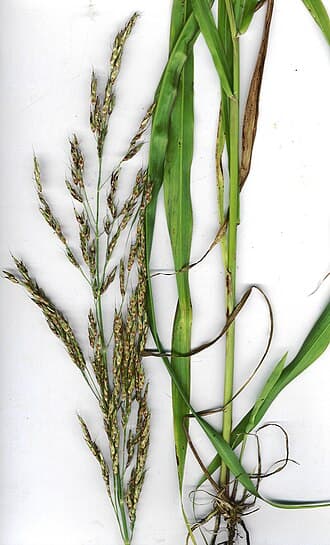
Grasses
Johnson Grass
Sorghum halepense
Season: Late spring through early fall, roughly May to October in the southern US, with peak pollen in summer.
Johnson grass is a tall, coarse perennial grass reaching 2.5 to 7 feet, related to cultivated sorghum and native to the Mediterranean region and western Asia. It spreads by both prolific seed and thick underground rhizomes, forming dense colonies, and is considered one of the world's worst agricultural weeds.
🇺🇸 History in the United States
Johnson grass was deliberately introduced to the United States as a promising forage crop, arriving in South Carolina from Turkey around 1830. It takes its name from Colonel William Johnson, who around 1840 planted it on his fertile river-bottom farm along the Alabama River, from which it spread through the Deep South. Its seeds moved with contaminated hay, livestock, farm equipment, and the expanding railroads, and by the late 19th century it had overrun bottomlands across the Cotton Belt; the USDA was already treating it as a serious pest, and it became a classic example of a forage introduction turned invasive. Genetic studies describe a multi-phase spread, with the plant later switching from cultivated fields into roadsides and disturbed habitats as it pushed north and west. It severely impacts corn, cotton, soybean, and grain sorghum production and is today listed as a noxious weed in about 20 states. As allergy testing panels developed in the 20th century, Johnson grass pollen was recognized as an important cause of hay fever and allergic asthma in the southern US, where it flowers over a long season; its group 1 allergen, Sor h 1, is homologous to the major allergens of other grasses.
📍 US Distribution
Johnson grass is now found in most of the lower 48 states but is most abundant in the Southeast, the southern Great Plains (it is a notorious weed in Texas), and California, favoring roadsides, field edges, and fertile bottomland.
🔗 Cross-Reactivity
As a warm-season (Panicoideae) grass, Johnson grass pollen cross-reacts strongly with related grasses such as Bahia grass and corn, and shows substantial cross-reactivity with Bermuda grass and group 1 allergens of other grasses.