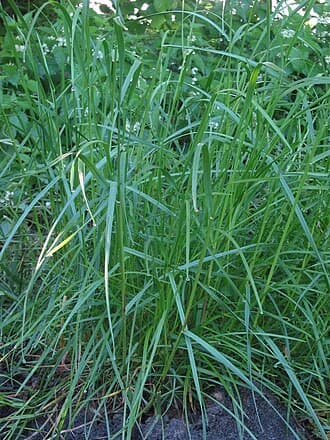
Grasses
Rye Grass
Lolium perenne
Season: Late spring to early summer in most of the US, roughly May through July, peaking in June.
Perennial ryegrass is a fine-textured, fast-germinating, cool-season bunchgrass native to Europe, temperate Asia, and North Africa. Prized for centuries as a pasture and lawn grass because it establishes quickly and tolerates grazing and mowing, it is also one of the world's most allergenic pollen producers.
🇺🇸 History in the United States
Perennial ryegrass holds the distinction of being one of the first grasses ever deliberately cultivated for pasture, sown in England as early as 1677, and it came to America with early European settlers who planted it for livestock forage; its presence in Virginia is documented by 1782. Through the 18th and 19th centuries it was a standard component of pasture and meadow seed mixes in the eastern states, and it later became a staple 'nurse grass' and overseeding grass because of its rapid germination. A defining chapter of its American history is the rise of the grass-seed industry in Oregon's Willamette Valley beginning in the early 20th century; the valley became the self-styled 'grass seed capital of the world,' producing most of the nation's ryegrass seed, and field burning and heavy pollen loads there made grass allergy a notable regional public-health issue. The first turf-type perennial ryegrass cultivars were released in the US in the early 1960s, vastly expanding its use in lawns and athletic fields. Ryegrass is also central to the scientific history of allergy: the pioneering fractionation work of Johnson and Marsh in 1965 isolated the major ryegrass pollen allergen 'Rye I' (now Lol p 1), one of the first pollen allergens ever purified, and about 95% of grass-pollen-allergic patients carry IgE to it.
📍 US Distribution
Perennial ryegrass is grown throughout the cooler, humid regions of the United States — the Northeast, Midwest, and especially the Pacific Northwest, where Oregon's Willamette Valley dominates commercial seed production — and it is widely overseeded on southern lawns and golf courses in winter.
🔗 Cross-Reactivity
Ryegrass pollen is extensively cross-reactive with other temperate Pooideae grasses such as timothy, Kentucky bluegrass, fescue, and orchard grass, so sensitization to one usually means reactivity to all.