Grasses
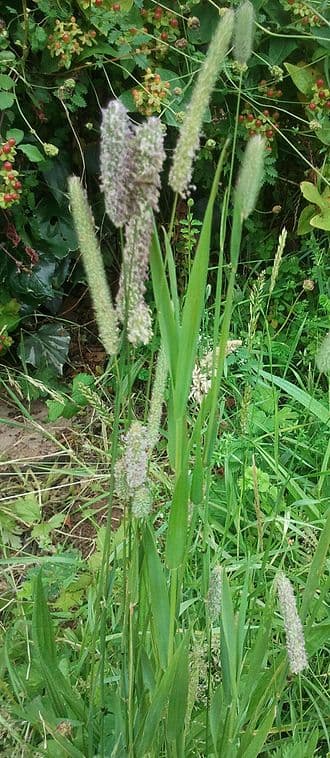
Timothy Grass
Phleum pratense
Season: Late spring through midsummer, typically May through July in most of the northern US, with peak pollen in June.
Timothy grass is a tall, cool-season perennial bunchgrass native to Europe and Asia, easily recognized by its dense, cylindrical, spike-like flower head. It is one of the most important hay grasses in the world, especially valued as horse hay, and its pollen is the international reference standard for grass allergy.
🇺🇸 History in the United States
Timothy arrived in North America unintentionally with early European settlers and was first noticed growing wild around 1711 by John Herd along the Piscataqua River near Portsmouth, New Hampshire, which earned it the early name 'Herd's grass.' Around 1720 a farmer named Timothy Hanson began promoting its cultivation for hay in Maryland and later in Virginia and the Carolinas, and the grass took his name; the first known written use of 'timothy' appears in a letter from Benjamin Franklin dated July 16, 1747. Through the 18th and 19th centuries timothy became the premier hay crop of the northern United States, feeding the horses that powered American farms, cities, and armies, and timothy-clover meadows were a fixture of northern agriculture well into the automobile age. Timothy also occupies a foundational place in allergy medicine: in 1911 Leonard Noon (and, after him, John Freeman) performed the first allergen immunotherapy using timothy grass pollen extract, launching the treatment still used today. Its major allergen, Phl p 1, was later characterized as the prototype of the group 1 grass allergens recognized by more than 90% of grass-pollen-allergic patients, and timothy extract remains the standard for grass allergy testing and grass-pollen vaccines in the US.
📍 US Distribution
Timothy is naturalized across most of the northern United States and at higher elevations farther south, and is cultivated for hay chiefly in the Northeast, upper Midwest, and mountain West; it performs poorly in the hot, humid Deep South.
🔗 Cross-Reactivity
Timothy pollen cross-reacts strongly with other temperate grasses such as ryegrass, Kentucky bluegrass, orchard grass, and fescue, and its Phl p 1 and Phl p 5 allergens serve as diagnostic markers for genuine grass-pollen sensitization.