Weeds
English Plantain
Plantago lanceolata
Season: Long season from spring through early fall, roughly April to September, peaking May-June alongside grasses.
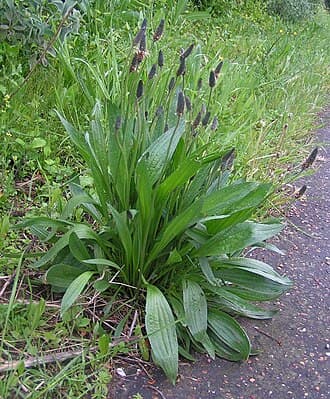
English plantain, also called narrowleaf plantain or ribwort, is a low perennial with a rosette of ribbed, lance-shaped leaves and slender stalks topped by short, cone-like flower heads ringed with white stamens. It is a ubiquitous weed of lawns, pastures, and roadsides, and it sheds wind-borne pollen over an unusually long season.
🇺🇸 History in the United States
English plantain arrived in North America with European colonization in the 1600s, its tiny sticky seeds carried in ship ballast, cargo, livestock feed, and the clothing of settlers, and it was also likely brought deliberately as a valued wound-healing herb. Plantain followed European settlement so faithfully that Native Americans named it for the newcomers: John Josselyn's New-Englands Rarities Discovered (1672) recorded that the Indians called plantain 'English-Mans Foot, as though produced by their treading,' and the name 'white man's footprint' has clung to the plantains ever since. The plant thrived precisely in the disturbed, trampled, grazed ground that colonial agriculture created, so its advance across the continent traced the frontier itself, moving with wagon roads, pastures, and clover and grass seed shipments through the 18th and 19th centuries. Plantago lanceolata has been established in North America for well over 200 years and eventually reached every state. Because it blooms from spring into fall — overlapping the grass season — American allergists in the 20th century identified it as a meaningful and sometimes underappreciated cause of spring and summer hay fever, and it remains a standard weed on US allergy test panels.
📍 US Distribution
Naturalized in all 50 states, common in lawns, pastures, and disturbed ground nearly everywhere.
🔗 Cross-Reactivity
Its major allergen Pla l 1 shows limited cross-reactivity with other weed pollens, though its season overlaps grasses and can confound diagnosis.