Weeds
Russian Thistle
Salsola tragus
Season: Summer through fall, roughly July to October.
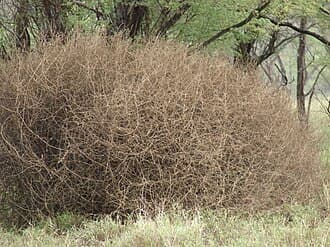
Russian thistle is the iconic tumbleweed of the American West — a bushy, spiny summer annual that breaks off at the base when mature and rolls with the wind, scattering seed as it goes. Despite its name it is not a true thistle but a member of the amaranth family, and its pollen is a major late-summer allergen in arid regions.
🇺🇸 History in the United States
Russian thistle has one of the best-documented and fastest plant invasions in American history. Native to southeastern Russia and western Siberia, it arrived around 1873 as a contaminant in flaxseed sown by Ukrainian immigrant farmers in Bon Homme County, South Dakota. From that single point of entry it spread with astonishing speed — carried by contaminated crop seed, threshing crews, railroad cars (especially livestock cars), and above all by its own tumbling habit, with each windblown plant scattering up to a quarter-million seeds across the open plains. Within about 20 years it had invaded 16 western states and several Canadian provinces, and by 1895 it had reached California and established along the West Coast; the invasion so alarmed farmers that the USDA dispatched investigators and Congress debated eradication schemes in the 1890s. Ironically, the despised invader became a symbol of the American West, romanticized in the 1930s by the Sons of the Pioneers' song 'Tumbling Tumbleweeds,' and its windrows piling against fences remain a familiar western scene. As aerobiology developed in the 20th century, Russian thistle was recognized as one of the most potent allergenic pollens of the arid West and Southwest, where its late-summer pollen is a leading cause of hay fever.
📍 US Distribution
Established in nearly every state — essentially all except Alaska and Florida — and most abundant in the arid and semi-arid West.
🔗 Cross-Reactivity
Its major allergen Sal k 1 cross-reacts with other Amaranthaceae pollens such as lambs quarter and pigweed.