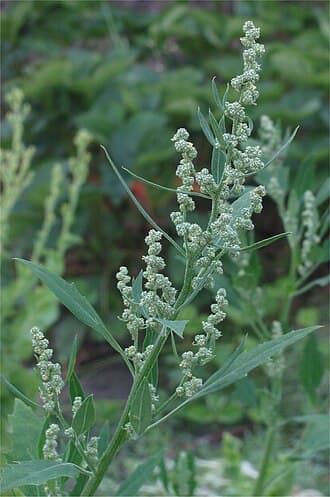
Weeds
Lambs Quarter
Chenopodium album
Season: Late summer to fall, roughly June through October, peaking August-September.
Lambs quarter, also called white goosefoot or fat hen, is a fast-growing annual weed of the amaranth family with mealy, white-dusted leaves. It thrives in gardens, farm fields, and disturbed ground, and its inconspicuous green flowers release large amounts of wind-borne pollen in late summer.
🇺🇸 History in the United States
Lambs quarter has a tangled history in America because the continent hosts both native and introduced forms. The weedy Eurasian variety, Chenopodium album var. album, is believed to have arrived with the very beginnings of European agriculture in the 1600s, carried as a contaminant of crop seed and soil, while a closely related native goosefoot, Chenopodium berlandieri, was actually one of the earliest cultivated crops of eastern North America — archaeologists have recovered domesticated seeds roughly 3,500 years old from the pre-maize Eastern Agricultural Complex, and lambsquarter-type seeds were used by Indigenous peoples for as much as 8,000 years. Many Indigenous nations, including the Apache, Navajo, Hopi, Paiute, Pima, and Pueblo peoples, ate the greens and ground the seeds into flour, and European colonists likewise valued the introduced plant as a potherb. As colonial and then industrial agriculture spread westward through the 18th and 19th centuries, the Eurasian form followed plowed fields and became one of the most ubiquitous farm weeds in the country. Because native and introduced varieties intergrade and were long confused by botanists, the exact timeline of its spread is murky, but by the 20th century it ranked among the most common agricultural weeds in every US state. Its heavy late-summer pollen production made it a recognized contributor to 'weed season' hay fever as American allergology developed in the early 1900s, particularly in the drier western and plains states where chenopod-amaranth pollen dominates the late-summer air.
📍 US Distribution
Found in all 50 states and throughout southern Canada, most abundant in cultivated fields, gardens, and disturbed soils.
🔗 Cross-Reactivity
Cross-reacts extensively with other Amaranthaceae/Chenopodiaceae pollens such as pigweed and Russian thistle.