Weeds
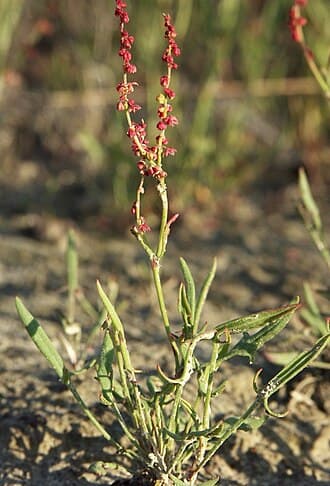
Sheep Sorrel
Rumex acetosella
Season: Late spring through mid-summer, roughly May to July, overlapping the grass pollen season.
Sheep sorrel is a small perennial of the buckwheat family with arrowhead-shaped, sour-tasting leaves and slender reddish flower stalks that give infested fields a rusty tinge in early summer. It spreads by creeping roots in acidic, depleted soils and is a prolific producer of wind-borne pollen.
🇺🇸 History in the United States
Sheep sorrel is a Eurasian native brought to North America by European settlers during the colonial period of the 1600s and 1700s, arriving as a contaminant of crop and pasture seed and possibly also carried deliberately as a salad and medicinal herb, since colonists used its tart, vitamin-rich leaves against scurvy. It naturalized quickly in New England's acidic, worn-out farm soils — its abundance became a folk indicator of 'sour' land needing lime — and it spread across the continent with colonial and then westward agricultural expansion, following cleared pastures, hayfields, and roadsides. By the 19th century it was naturalized throughout temperate North America and was a familiar nuisance in lawns, strawberry fields, and thin pastures. In the 20th century it acquired a place in American folk medicine as an ingredient of the Essiac herbal formula popularized in the 1920s. Allergists came to recognize it as the primary source of allergenic Rumex (dock/sorrel) pollen in the United States — a single plant can release roughly 400 million pollen grains — and although rated a moderate hay fever inducer, its late-spring shedding overlaps grass season and contributes measurably to early-summer allergy in much of the country.
📍 US Distribution
Naturalized in all 50 states, most common in acidic, sandy, or depleted soils of pastures, lawns, and roadsides.
🔗 Cross-Reactivity
Cross-reacts mainly with other Rumex (dock and sorrel) species, with little cross-reactivity to unrelated weed pollens.