Weeds
Western Ragweed
Ambrosia psilostachya
Season: Late summer through fall, roughly August to October or until first frost.
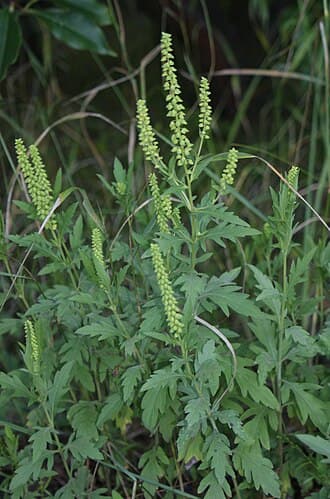
Western ragweed is a perennial ragweed with grayish, deeply lobed leaves that spreads by creeping roots to form dense colonies on prairies, rangeland, and roadsides. Like its annual cousins it is wind-pollinated, and its abundant fall pollen makes it a principal cause of hay fever in the central and western United States.
🇺🇸 History in the United States
Western ragweed is a true American native, occurring naturally across most of North America — nearly all of the continental United States, southern Canada, and northern Mexico — long before European contact. Indigenous peoples knew and used it medicinally: Pueblo women in New Mexico drank western ragweed tea during difficult childbirth, the Cheyenne of the Central Plains treated colds and intestinal ailments with it, and the Kiowa of Oklahoma applied it to sores on people and horses. European settlement dramatically expanded its abundance, since ragweeds are disturbance specialists that flourished in the overgrazed range, broken prairie, and roadsides that 19th-century agriculture created across the plains. The ragweeds also occupy a founding place in American allergy history: Boston physician Morrill Wyman identified ragweed pollen as the cause of the 'autumnal catarrh' form of hay fever, publishing his landmark book in 1872 after experimentally inducing attacks by sniffing the pollen, and his work helped launch both American allergology and the fashionable White Mountains 'hay fever resorts.' Oren C. Durham's first national atmospheric pollen survey, published in 1929, mapped the enormous late-summer ragweed pollen storms across the country, and western ragweed was established as the dominant perennial ragweed of the plains and far West. Its wind-blown pollen remains a leading cause of fall allergic rhinitis and asthma in those regions today.
📍 US Distribution
Native across nearly the entire continental United States, most abundant on the Great Plains and in the West, including California grasslands and disturbed ground.
🔗 Cross-Reactivity
Cross-reacts strongly with other ragweeds via Amb a 1-homologous allergens, and partially with mugwort and other composite weeds.