Trees
Acacia
Acacia spp.
Season: Late winter to early spring, roughly February through March in California.
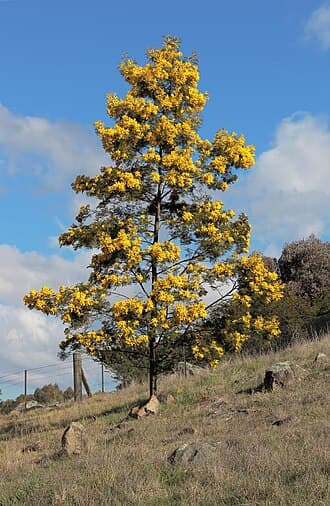
Acacias are fast-growing trees and shrubs in the legume family, best known in the US as the Australian 'wattles' with feathery foliage and masses of fragrant yellow flowers that bloom in late winter. Several species are grown as ornamentals in warm-climate states, while native acacia relatives grow wild in the desert Southwest.
🇺🇸 History in the United States
A few acacia relatives (such as catclaw acacia) are native to the American Southwest, but the acacias that matter most for US allergy sufferers are Australian species imported to California during the horticultural boom that followed the Gold Rush era of the mid-1800s. Nurserymen introduced silver wattle (Acacia dealbata), Sydney golden wattle (A. longifolia), and blackwood acacia (A. melanoxylon) as landscape ornamentals, street trees, windbreaks, and timber trees, and poet-naturalist Joaquin Miller famously planted acacias in the Oakland hills at the end of the 19th century. The trees thrived in California's Mediterranean climate and by the 20th century several species had escaped cultivation and naturalized along the coast, with blackwood and silver wattle now listed as invasive by the California Invasive Plant Council. Because acacias bloom conspicuously in February and March, they were historically blamed for winter hay fever, and acacia pollen extracts entered US allergy testing panels in the 20th century. Modern aerobiology has tempered that reputation: acacias are largely insect-pollinated with heavy pollen that travels poorly, so they are considered only mildly allergenic and important mainly near the trees themselves. They remain fixtures of California and Gulf Coast landscaping, and related wattles such as black wattle have been profiled as allergens of note in the allergy literature.
📍 US Distribution
Ornamental and naturalized acacias are concentrated in California, with plantings in Arizona, the Gulf Coast, and Florida; native acacia relatives occur across the desert Southwest and Texas.
🔗 Cross-Reactivity
Acacia pollen shows cross-reactivity with other legume-family (mimosa/mesquite) pollens, and its major allergen has similarity to grass group-1 allergens in some studies.