Trees
Walnut Tree
Juglans spp.
Season: Spring, roughly April through June.
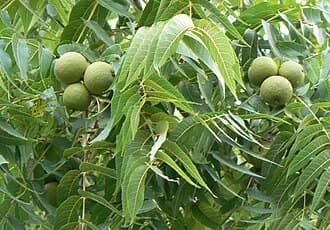
Walnuts are large deciduous nut trees that include the native black walnut of eastern forests and the introduced English (Persian) walnut grown in orchards. They release moderate amounts of wind-borne pollen from catkins in spring. Pollen exposure is heaviest near California and Oregon nut orchards and in areas with abundant wild black walnut.
🇺🇸 History in the United States
The black walnut (Juglans nigra) is native to the eastern United States and has been part of American life since pre-colonial times — Native Americans harvested the nuts and used the husks for dye, and colonists quickly made its rich dark wood one of the most prized furniture and gunstock timbers in the country, a status it has held since the 17th century. Native butternut (Juglans cinerea) and California black walnuts (J. hindsii and J. californica) extended the genus across the continent. The English walnut (Juglans regia), native to Eurasia, arrived with the Franciscan missionaries around the 1770s (early trees were called 'mission walnuts'), but the modern industry began when commercial orchard planting started in California in 1867 with Joseph Sexton's plantings near Goleta; the industry later concentrated in the Central Valley, and California now grows about 99 percent of all US walnuts and a large share of world production. Northern California black walnut rootstock became standard for these orchards, further embedding walnuts in the state's agricultural landscape. Walnut pollen was recognized in the 20th century as a regional cause of pollinosis: aerobiological studies reported it as a serious springtime allergen in California and Oregon, especially in communities surrounded by nut orchards, and walnut pollen is included in allergen panels as t10. In eastern states, wild black walnut contributes more modestly to the spring tree pollen load, and its allergy role is often overshadowed by the separate and more severe food allergy to walnuts themselves.
📍 US Distribution
Black walnut grows throughout the eastern and central United States; English walnut orchards are concentrated in California's Central Valley, with California black walnuts native to that state's valleys and foothills.
🔗 Cross-Reactivity
Walnut pollen cross-reacts with pollens of related Juglandaceae such as hickory and pecan, and shows some cross-reactivity with other Fagales tree pollens.