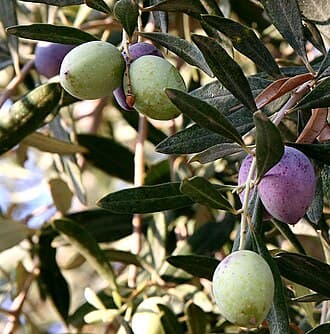
Trees
Olive
Olea europaea
Season: Spring, roughly April through June (as early as March in low deserts).
The olive is a long-lived Mediterranean evergreen grown in the United States both for fruit and oil and as a drought-tolerant ornamental. Its inconspicuous spring flowers release potent wind-borne pollen containing the major allergen Ole e 1. In the desert Southwest, olive pollen proved so allergenic that several counties banned planting fruiting olive trees.
🇺🇸 History in the United States
Olives were introduced to what is now the United States by Franciscan missionaries, who planted the first trees at Mission San Diego de Alcala in 1769 using stock carried up from San Blas, Mexico, intending to press oil for the missions; by 1823 olives were being grown at 21 California missions, giving rise to the 'Mission' olive cultivar developed along El Camino Real in the late 18th century. After the mission era, commercial olive growing expanded in California in the late 19th century, and the state remains the center of US table olive and olive oil production. In the 20th century the olive found a second career as a tough, drought-tolerant ornamental and was planted by the tens of thousands in Arizona, Nevada, and inland California suburbs — with unforeseen consequences, since a single tree can release billions of pollen grains and olive pollen is among the most sensitizing aeroallergens of the arid Southwest. Public health concern mounted through the 1970s-80s, and in 1984 the Pima County (Tucson) Board of Supervisors passed the nation's first olive-pollen ordinance, banning new plantings of olive (and mulberry) effective January 1985; Boulder City, Nevada followed with a similar ordinance in May 1985, Las Vegas/Clark County banned fruiting olives in 1991, and Maricopa County (Phoenix) enacted comparable restrictions. The bans allow existing trees to remain and generally exempt certified low-pollen or 'fruitless' cultivars, and they remain in force — and periodically debated — today.
📍 US Distribution
Grown commercially in California's Central Valley and increasingly in Arizona and Texas, and widely planted as an ornamental across California, Arizona, Nevada, and other warm, dry regions.
🔗 Cross-Reactivity
Olive pollen cross-reacts strongly with ash, privet, and other members of the Oleaceae family via the Ole e 1 allergen.
Sources
- https://en.wikipedia.org/wiki/Mission_olive
- https://www.upi.com/Archives/1988/01/12/Science-Today-Olive-branch-no-peace-symbol-for-allergy-sufferers/6967568962000/
- https://lasvegassun.com/news/2017/feb/26/extending-a-branch-to-a-much-maligned-las-vegas-va/
- https://tucson.com/opinion/local/mort-rosenblum-its-time-to-end-the-pima-county-ban-on-olive-trees/article_d3b25a0e-06a9-11ec-9f78-1bc9ed83d57a.html