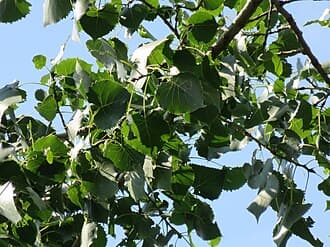
Trees
Cottonwood
Populus deltoides
Season: Early spring, roughly February through April in most of its range (the cottony seeds appear later, June to mid-July).
The eastern cottonwood is a massive, fast-growing poplar of river bottoms and floodplains, named for the cottony white fluff that carries its seeds in early summer. Male trees release wind-borne pollen in early spring, well before the familiar 'cotton' flies.
🇺🇸 History in the United States
Eastern cottonwood is native to the United States and was ecologically and culturally central to the Great Plains long before European settlement: the Dakota, Lakota, Cheyenne, and Pawnee used it for food, medicine, ceremony (including the Sun Dance), and winter livestock and horse feed. For 19th-century travelers on the Oregon and Santa Fe Trails, cottonwoods were lifelines — often the only trees visible for miles, their tall crowns marked water courses and served as navigational landmarks, earning the species the nickname 'Pioneer Tree of the Plains.' Settlers pushing into the Plains in the 1800s planted cottonwoods along streams and around homesteads because the species was frequently the only timber, fuel, and shade available, and it later figured in shelterbelt plantings. Its pioneer legacy was formalized when Kansas designated it the state tree in 1937, and Nebraska later did the same (1972). In the 20th century, cottonwood also became important to forestry as one of the fastest-growing North American hardwoods, planted for pulp and biomass. Allergy-wise, cottonwood/poplar pollen has long been included in US spring pollen counts and test panels as a moderate allergen; notably, the early-summer 'cotton' that the public often blames for symptoms is seed fluff, not pollen — the actual allergenic pollen flies weeks earlier, overlapping with other spring tree pollens.
📍 US Distribution
Native throughout the eastern and central US, from the Atlantic coast across the Great Plains, where the plains cottonwood variety lines nearly every prairie watercourse; related cottonwood species extend the genus into the West.
🔗 Cross-Reactivity
Cottonwood pollen cross-reacts with other Populus species (aspens and poplars) and to a lesser degree with willows in the same family.