Trees
Mulberry
Morus spp.
Season: Spring, roughly February through April in the Southwest and March through June farther north.
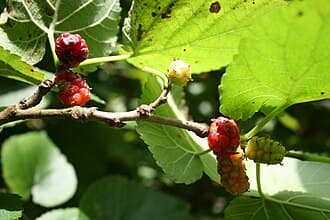
Mulberries are fast-growing deciduous trees bearing blackberry-like fruit; the native red mulberry and the introduced white mulberry are the most common in the United States. Male trees release enormous quantities of highly allergenic wind-borne pollen in spring. In several Southwestern cities mulberry pollen became such a public health problem that planting the trees was banned.
🇺🇸 History in the United States
The red mulberry (Morus rubra) is native to the eastern United States, but the white mulberry (Morus alba) was deliberately introduced from Asia for silk production: British colonists were bringing white mulberry trees and silkworms to Virginia as early as 1623, encouraged by King James I, and in 1624 the Virginia legislature required every male resident to plant at least four white mulberry trees to found an American silk industry. Colonial silk ventures repeatedly failed, yet the dream persisted, culminating in the 1830s 'mulberry mania' — a speculative bubble in Morus multicaulis trees across the eastern states that collapsed by the end of that decade when cold winters and disease killed the plantations. The abandoned trees naturalized widely, and white mulberry is now considered invasive across much of the country, hybridizing with and displacing native red mulberry. In the mid-20th century, nurseries promoted 'fruitless' mulberry cultivars — all-male clones selected to avoid messy berries — as fast shade trees for new Sun Belt suburbs, inadvertently mass-planting the sex of the tree that produces all of the pollen. By the 1980s and 1990s mulberry pollen counts in desert cities were among the highest ever recorded, and cities and counties acted: Pima County (Tucson) banned new mulberry (and olive) plantings in 1984, Las Vegas outlawed planting fruitless mulberries in 1991, and El Paso and Albuquerque enacted similar bans in the early 1990s. Mulberry remains a top springtime allergen in the Southwest even as the aging banned trees die off.
📍 US Distribution
Red mulberry occurs throughout the eastern half of the country; naturalized white mulberry is found in nearly every state, with planted fruitless mulberries especially common in Southwestern cities like Phoenix, Tucson, El Paso, Albuquerque, and Las Vegas.
🔗 Cross-Reactivity
Mulberry pollen shows cross-reactivity with other Moraceae members such as fig and paper mulberry, and mulberry-sensitized patients often react to multiple spring tree pollens.
Sources
- https://www.mountvernon.org/the-estate-gardens/gardens-landscapes/plant-finder/item/white-mulberry
- https://connecticuthistory.org/connecticuts-mulberry-craze/
- https://elpasomatters.org/2021/11/29/3-decades-into-el-pasos-ban-on-new-mulberries-existing-trees-are-nearing-end-of-life/
- https://www.aspireallergy.com/blog/mulberry-trees