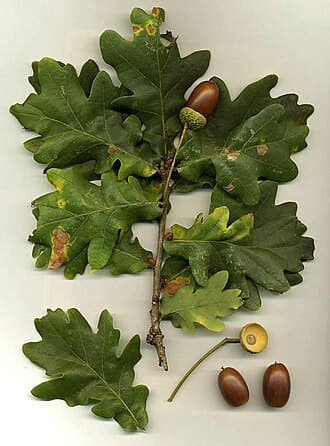
Trees
Oak
Quercus spp.
Season: Spring — roughly February through June depending on latitude, peaking March to May in most of the country.
Oaks are the dominant hardwood trees of North America, ranging from towering white and red oaks of eastern forests to evergreen live oaks of the South and California. They shed massive quantities of lightweight, wind-dispersed pollen each spring. Because oaks are so abundant and their season so long, oak is one of the most important tree pollen allergens in the United States.
🇺🇸 History in the United States
Oaks are thoroughly native to the United States — with roughly 90 recognized species, Quercus is the largest genus of trees native to the country, and oaks cover about 11 percent of the North American landmass. They have been central to American life since before European contact: acorns were a staple food for many Native American peoples, especially in California, and colonists prized white oak for ship timbers, barrels, and buildings — the frigate USS Constitution ('Old Ironsides,' launched 1797) earned its nickname from its live oak hull. Through the 19th century oak underpinned the tanning industry (tanbark), railroads, and furniture making, and remains the most economically important hardwood genus in North America. The oak's cultural stature was formalized in 2004 when Congress designated the oak as America's national tree following a National Arbor Day Foundation vote. As clinical allergy developed in the early-to-mid 20th century, oak pollen was recognized as a major regional aeroallergen — southern and eastern cities can see oak counts in the thousands of grains per cubic meter each spring, famously coating cars in yellow-green dust — and oak (allergen t7, with major allergen Que a 1) became a standard part of diagnostic panels. Oak has one of the longest pollen seasons of any allergenic tree, and heavy urban planting of oaks as street and shade trees has kept exposure high; studies continue to rank oak among the worst trees for spring allergy sufferers in the US.
📍 US Distribution
Oaks occur in every one of the lower 48 states, dominating eastern deciduous forests, southern live oak country, Texas hill country, and California's oak woodlands.
🔗 Cross-Reactivity
Oak pollen cross-reacts with birch, alder, and other Fagales pollens through the Bet v 1-homologous allergen Que a 1.