Trees
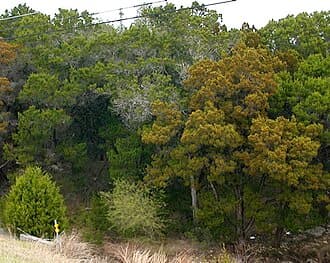
Mountain Cedar
Juniperus ashei
Season: Winter, from roughly mid-November through February, peaking in December and January.
Mountain cedar, properly Ashe juniper, is a scrubby evergreen juniper that dominates the limestone hills of central Texas. Unlike almost every other tree, it releases enormous clouds of pollen in the dead of winter, causing the notorious 'cedar fever' allergy season.
🇺🇸 History in the United States
Ashe juniper is native to the south-central United States, and pollen records show it has been common in the Texas Hill Country for at least 16,000 years, where it grows on the limestone of the Edwards Plateau. In the 19th century, settlers valued its rot-resistant wood for fence posts, telegraph poles, and railroad ties, and 'cedar choppers' made a living clearing and cutting the brakes. Paradoxically, settlement helped the tree explode in abundance: fire suppression, overgrazing by cattle, and the soil erosion that followed poor land management after the late 1800s allowed the hardy juniper to spread from canyon refuges across millions of acres of former grassland, a spread that has continued over the past century. Its winter pollen release made it a uniquely miserable allergen, and Texans' 'cedar fever' was recognized clinically nearly a century ago — Dallas physician J.H. (Harvey) Black published on 'cedar hay fever' in the very first volume of the Journal of Allergy in 1929. Mountain cedar has since been established as one of the most potent seasonal allergens in North America, its major allergen protein identified as Jun a 1, and December-January pollen counts in central Texas rank among the highest recorded for any plant in the country. Cedar fever remains a defining seasonal affliction of Texas life, driving allergy clinic visits, pollen forecasting, and even brush-clearing campaigns across the Hill Country.
📍 US Distribution
Concentrated in central Texas on the Edwards Plateau and Hill Country west of Interstate 35, extending into Oklahoma, Arkansas, and southern Missouri, with wind-blown pollen affecting areas far downwind.
🔗 Cross-Reactivity
Mountain cedar pollen cross-reacts strongly with other cypress-family pollens, including eastern red cedar, Japanese cedar, and Mediterranean cypress.