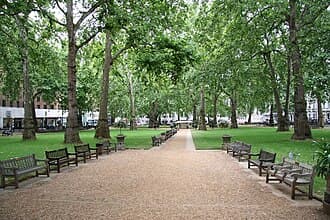
Trees
Maple Leaf Sycamore
Platanus × acerifolia
Season: Spring, roughly March through May.
The maple leaf sycamore, better known as the London plane tree, is a hybrid of the American sycamore and the Oriental plane with large maple-like leaves and distinctive flaking, camouflage-patterned bark. Prized for its extraordinary tolerance of pavement, pollution, and pruning, it became the default big street tree of many world cities. Its spring pollen, along with irritating leaf hairs shed in spring, makes it a meaningful urban allergen.
🇺🇸 History in the United States
The hybrid itself arose in Europe — the cross between the American sycamore and Oriental plane is thought to have occurred around the 1640s, with one tradition placing an early specimen in King Charles I's garden by 1663 — and it was brought back across the Atlantic to America in colonial times, becoming widely planted in Philadelphia, New York, and other East Coast cities in the 18th and 19th centuries. Its reputation for surviving coal smoke and compacted soil, helped by exfoliating bark that sheds accumulated pollutants, made it the street-tree of choice during the great urban planting campaigns of the late 19th and early 20th centuries. In New York City, Parks Commissioner Robert Moses (1934-1960) championed the species and had it planted 'just about everywhere'; the Parks Department's leaf logo is widely thought to be modeled on a London plane leaf, and the 1996 tree census found it made up over 18 percent of the city's street trees (still about 10 percent of nearly 600,000 street trees today). On the West Coast it was famously adopted, after much controversy, for Market Street in San Francisco and University Avenue in Palo Alto. Because the tree is so overwhelmingly concentrated in cities, allergists came to recognize plane (sycamore) pollen in the 20th century as a distinctly urban springtime allergen, with sensitization rates highest in heavily planted cities; the tree's spring shedding of fine, bristly leaf and fruit hairs also causes throat and eye irritation that compounds the pollen problem. In recent decades some cities have reconsidered new plantings due to both allergy concerns and overreliance on a single hybrid.
📍 US Distribution
Planted as a street and park tree in cities throughout most of the country, from the Northeast and Mid-Atlantic to the Pacific Coast; it is an urban tree and rarely naturalizes far from planting sites.
🔗 Cross-Reactivity
Cross-reacts with other Platanus species (including native American sycamore) and has reported associations with certain plant foods such as hazelnut and banana.
Sources
- https://www.missouribotanicalgarden.org/PlantFinder/PlantFinderDetails.aspx?kempercode=a892
- https://slate.com/technology/2024/03/london-planetrees-new-york-parks-nonnative-species-bad-why.html
- https://www.newporttreeconservancy.org/featured-trees/london-planetree-platanus-x-acerfolia
- https://trees.stanford.edu/ENCYC/PLATace.htm