Trees
Common Silver Birch
Betula pendula
Season: Spring, roughly March through May depending on latitude, often peaking in April.
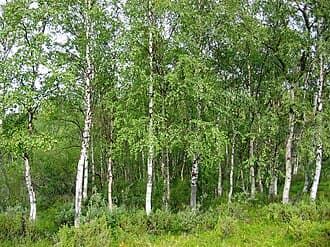
The common silver birch, also called European white birch or weeping birch, is a graceful tree with peeling white bark and drooping branch tips. Native to Europe and northern Asia, it was brought to America as a garden and lawn tree and produces highly allergenic wind-borne pollen in spring.
🇺🇸 History in the United States
Betula pendula is not native to North America; it was introduced from Europe as an ornamental during the colonial and early national periods and became one of the most popular white-barked lawn trees of the 19th and 20th centuries, prized for its elegant weeping form and brilliant white bark. Widespread planting in yards, parks, and cemeteries across the northern United States allowed the tree to escape cultivation, and it has naturalized in parts of the Northeast, Upper Midwest, and Pacific Northwest, where it is now listed as invasive in states including Kentucky, Maryland, Washington, and Wisconsin. Its ornamental heyday faded in the late 20th century as the bronze birch borer devastated plantings — in some documented cases killing every European white birch within about eight years of planting — pushing landscapers back toward native river birch. Medically, birch became one of the most important tree allergens in the world: its major pollen protein, Bet v 1, was among the first tree allergens cloned (in 1989) and binds IgE in more than 95% of birch-allergic patients. In the northern US, silver birch pollen adds to the load from native birches each spring and is a standard component of American skin-test panels and immunotherapy. Birch allergy also gained attention from the 1980s onward as the classic driver of pollen-food (oral allergy) syndrome to apples, cherries, and other fruits.
📍 US Distribution
Planted and locally naturalized across the northern tier of the US, from New England and the Great Lakes states to the Pacific Northwest and mountain West; it performs poorly in the hot Southeast.
🔗 Cross-Reactivity
Birch pollen cross-reacts strongly with alder, hazel, hornbeam, and oak pollens and with Bet v 1-related food proteins in apples, stone fruits, hazelnuts, and celery (oral allergy syndrome).