Trees
Elm
Ulmus americana
Season: Late winter to early spring, roughly February through April (some introduced elm species also pollinate in fall).
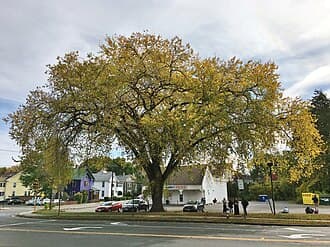
The American elm is a stately native shade tree with a graceful vase-shaped crown that once arched over main streets across the country. It flowers and sheds wind-borne pollen very early in spring, before its leaves emerge.
🇺🇸 History in the United States
The American elm is native to eastern and central North America and was woven into US history from the start — colonial-era landmarks included famous elms such as Boston's 'Liberty Tree,' and the tree symbolized civic life in early America. Because of its beauty, fast growth, and tolerance of urban conditions, it became the premier street tree of the 19th and early 20th centuries: urban planners lined avenues with elms planted closely in monoculture rows, which is why nearly every American town has an 'Elm Street.' That very ubiquity set up one of the great ecological disasters in US history: Dutch elm disease, a fungal pathogen spread by bark beetles, arrived around 1930 on elm logs imported from Europe for furniture veneer, was detected in Ohio in 1930 and found again in New England in 1933, and had spread across more than 5,500 square miles by 1940. The nation's roughly 77 million elms in 1930 fell to about 34 million by 1976, hollowing out shaded streetscapes from New England to the Midwest, though survivors persist in places such as Central Park's Mall in New York and on the National Mall, and disease-tolerant cultivars like 'Valley Forge' and 'Princeton' have been developed by USDA and other breeders since the late 20th century. Throughout this history elm pollen remained a recognized early-spring aeroallergen, included in standard US skin-test panels; ironically, the loss of urban elms reduced elm pollen loads in many cities even as introduced Asian and Siberian elms (some fall-blooming) extended elm allergy seasons in the South and West. Restoration efforts by the National Park Service, USDA, and nonprofit groups continue today to return the species to American streets and forests.
📍 US Distribution
Still widespread as scattered wild trees throughout the eastern and central US from the Great Plains to the Atlantic, though large mature specimens are now uncommon; disease-tolerant cultivars are replanted in cities nationwide.
🔗 Cross-Reactivity
Elm pollen cross-reacts among Ulmus species (American, Siberian, Chinese, and slippery elm).
Sources
- https://www.ebsco.com/research-starters/history/dutch-elm-disease-arrives-united-states
- https://www.centralparknyc.org/articles/american-elms-central-park-mall
- https://www.nps.gov/articles/000/research-brief-restoring-the-american-elm-with-genetics.htm
- https://mortonarb.org/plant-and-protect/trees-and-plants/american-elm/