Trees
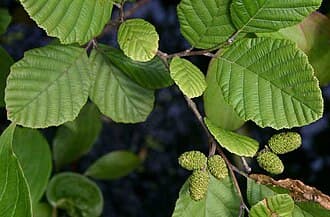
Grey Alder
Alnus incana
Season: Late winter to early spring, roughly January through April depending on region (earliest in the Pacific Northwest).
Grey alder is a fast-growing, moisture-loving tree in the birch family that lines streams, wetlands, and riverbanks. It produces dangling catkins that release large amounts of wind-borne pollen very early in the year, often before most other trees have begun to bloom. Because it flowers so early, it is one of the first triggers of tree pollen allergy each season.
🇺🇸 History in the United States
Unlike many allergenic trees, grey alder is largely native to the United States: the species is circumboreal, and its North American subspecies — speckled alder (Alnus incana ssp. rugosa) in the Northeast and Great Lakes region and thinleaf or mountain alder (ssp. tenuifolia) in the West — have grown along American waterways since before European settlement, having recolonized the continent after the last glaciation. Speckled alder ranges from the northern forests of Canada and the Maritime Provinces south into New England and the Lake States, while mountain alder extends from Alaska and the Pacific Northwest down the Rocky Mountains at elevations of roughly 4,500 to 10,000 feet. The European subspecies (ssp. incana) was later introduced by horticulturists and land managers as an ornamental and for reclamation of wet, disturbed, and mine-spoil sites, since alders fix nitrogen and stabilize soil. Historically, Native Americans and early settlers used alder bark for dyes and medicine, and the thickets were valued for streambank protection and wildlife cover rather than timber. Alder's allergy significance was recognized in the 20th century as aerobiology developed, when researchers found its pollen shares major allergens with birch, making it a key early-season sensitizer; alder counts in the Pacific Northwest, where red and speckled alders are abundant, can be among the highest tree pollen counts recorded in the country from late winter onward. Today alder is routinely included in standard skin-test panels (Thermo Fisher allergen t2) and is a significant contributor to allergic rhinitis, rhinoconjunctivitis, and asthma in northern states.
📍 US Distribution
Native subspecies occur across Alaska, the Pacific Northwest, the Rocky Mountains, the Great Lakes region, New England, and the upper Midwest, almost always along streams, wetlands, and other moist ground.
🔗 Cross-Reactivity
Strongly cross-reactive with birch, hazel, and hornbeam pollens (Fagales/Bet v 1 family), and associated with oral allergy syndrome to apples, cherries, and hazelnuts.